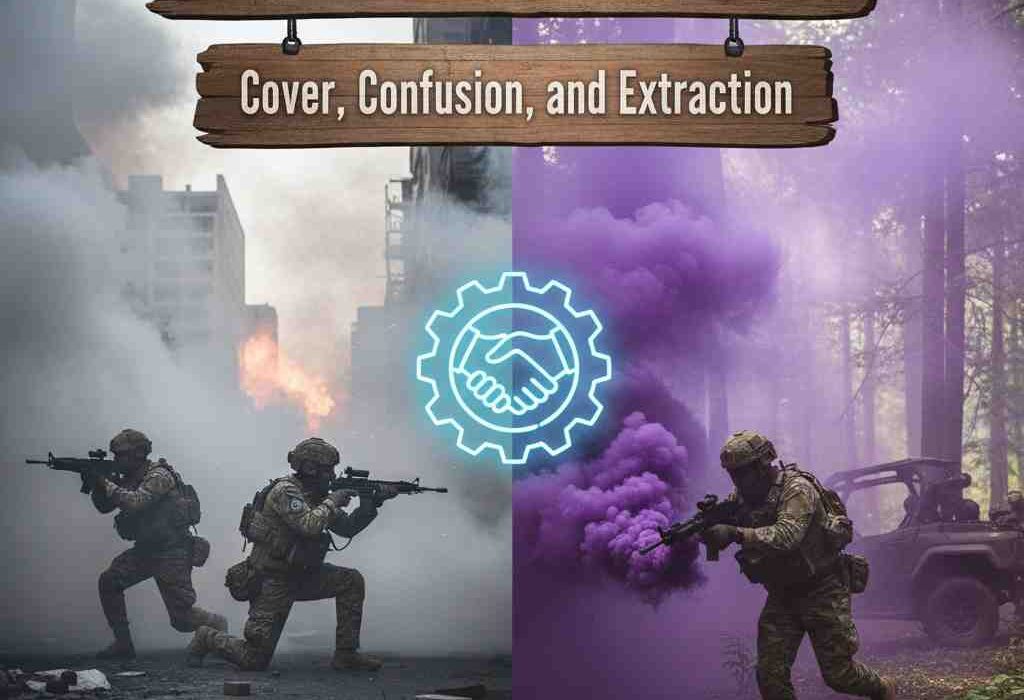
Smoke is one of those simple tools that can drastically change a small-unit fight. It denies sight, reshapes engagement geometry, and creates temporary windows to move or extract. Used well, smoke multiplies your options; used poorly, it creates chaos for your own side. This post explains what smoke gives you, how to think about using it, and how to practice so it helps—not hurts—your team.
What smoke actually does (and why teams use it)
At a basic level, smoke manipulates perception and time:
- Denies observation. It breaks visual contact and hides movement across exposed ground.
- Shapes decision making. Opponents forced to operate “in the fog” slow down and make conservative choices.
- Creates breathing room. Teams can use screened moments to reposition, extract casualties, or withdraw.
- Marks and signals. When coordinated, color or placement can indicate rally points or landing zones.
Think of smoke as a temporary change to the battlefield’s architecture—short-term walls and curtains you can move through if you’ve already planned how to use them.
The right questions to ask before you plan smoke
Before you ever reach for a canister or call for a smoke screen, answer these simple mission-focused questions:
- What’s the objective? (cover a move, mask withdrawal, screen medevac, mark a point)
- Who benefits most? (your moving element, evac team, or support assets)
- What are environmental risks? (wind, slopes, buildings that channel smoke back to you)
- What are civilian/operational risks? (is smoke likely to harm noncombatants or impede friendly aircraft?)
- What’s the fallback if it behaves differently? (wind change, quick dissipation)
If you can’t answer these clearly, don’t use smoke. The worst outcome is smoke that helps the enemy or blinds your own team.
Roles & choreography — keep it simple
Smoke use is choreography, not improvisation. Assign roles ahead of time:
- Initiator: the person/team responsible for creating and sustaining the smoke window.
- Mover(s): the element that will take advantage of the screen (extraction team, assault element, casualty carrier).
- Cover: teams that maintain overwatch and prevent flanking or exploitation during the smoke window.
- Communicator: someone monitoring wind/visibility and calling “go/hold/fade” so teams act together.
Prearranged simple cues (one-word radio calls or a hand signal) beat long sentences under stress. Rehearse those cues until they’re automatic.
Environmental and human factors that change everything
Smoke behaves like weather—local and often unpredictable. A gust, thermal updraft, or urban canyon can send smoke exactly where you don’t want it. Also remember:
- Your visibility drops too. Don’t assume your side can see through it better than the enemy.
- Respiratory and equipment effects. Smoke can irritate lungs and sensors; some obscurants reduce thermal or optical systems differently.
- Civilian & aviation impact. Smoke near roads, populated areas, or flight paths creates serious collateral hazards. Always factor non-combatants into your decision.
If a single environmental factor could negate the screen, pick another tool.
When smoke is a good choice — practical scenarios
Smoke is worth considering when it directly enables an otherwise risky action:
- Short, covered movement across an exposed lane (repositioning or crossing a road).
- Casualty extraction where a moving, obscuring curtain reduces the enemy’s ability to target litter/vehicle.
- Controlled withdrawal to break direct observation while the element regroups.
- Signal/mark for friendly assets when color or placement is coordinated and safe.
If your objective is vague or non-urgent, don’t create fog for the sake of fog.
Train like you intend to use it
Don’t “figure it out” in the field. Train deliberately:
- Dry runs to practice timing and movement without devices.
- Live validation in controlled ranges so teams learn how smoke drifts in your local terrain.
- Cross-training with medevac, vehicle, and aviation partners so everyone knows what a smoke window means operationally.
- After-action reviews to capture what worked and what didn’t (wind patterns, timing errors, comms breakdowns).
Training turns risky improvisation into a repeatable capability.
Safety, legality, and restraint
Smoke isn’t a free pass. It carries safety, environmental, and legal obligations. Avoid improvised or toxic obscurants. Don’t deploy where fire risk, civilians, or aircraft safety would be compromised. When in doubt, pick an option that reduces harm.
Final thought — smoke is a tool, not a trick
Used thoughtfully, smoke provides time and options: a temporary curtain that lets you choose the moment to move. But it’s never automatic. The best teams treat smoke like any other mission resource—planned, rehearsed, and used with restraint. Do that and smoke stops being a gamble and starts being an asset.