
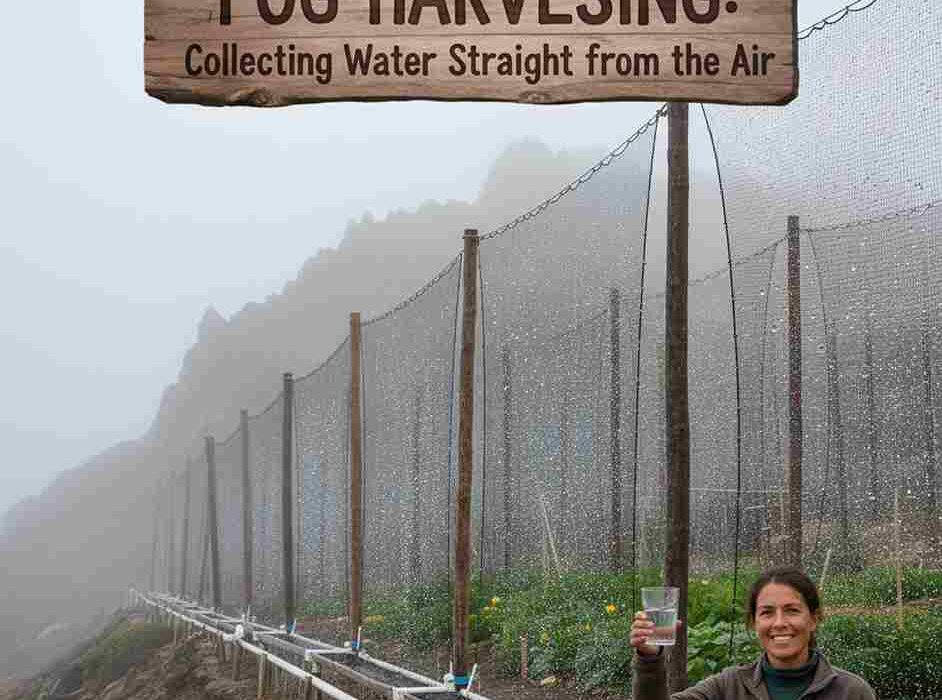
Imagine a technology that turns mist into a clean, fresh water source, requiring no energy and leaving almost no environmental footprint. This isn’t science fiction; it’s fog harvesting, a brilliant, low-tech solution already transforming lives in some of the driest coastal regions on Earth.
Fog harvesting is the process of using large nets to capture tiny droplets of water suspended in the air, essentially turning a cloud into a community water tap.
🕸️ How the Magic Works: The Science of the Net
The core technology behind fog harvesting is surprisingly simple, relying on basic physics and the right materials.
- The Concept: Fog is a low-lying cloud, and when it encounters a physical barrier, its water droplets condense, or coalesce, into larger, heavier drops that fall due to gravity.
- The Collector: This barrier is typically a large, vertical net made of a fine-mesh fabric, like polypropylene or nylon. These nets are strategically placed on hills or ridges where fog frequently rolls in.
- The Process:
- The wind pushes the fog through the mesh net.
- The tiny droplets collide and adhere to the fibers.
- As more droplets accumulate, they become heavy enough to drip down the mesh.
- The water is collected in troughs or gutters at the bottom of the net, filtered, and piped into storage tanks or distribution systems.

🌍 A Solution for Water Scarcity
Fog harvesting is most effective in regions that meet two criteria: high rates of advection fog (fog blown horizontally by the wind) and significant water scarcity.
- Coastal Deserts: Areas like the Atacama Desert in Chile, the coastal hills of Morocco, and parts of Peru have perfected this technology. The cold ocean currents off these coasts create dense, persistent fog (known locally as camanchaca or garúa) that provides a consistent water source where traditional rainfall is nearly non-existent.
- Sustainable and Decentralized: Because fog harvesting requires no external energy source—just wind and gravity—it is an incredibly sustainable and cost-effective solution, especially for remote or mountain-top communities that lack access to centralized infrastructure.
📈 The Impact and Potential
The results of successful fog harvesting projects are tangible and life-changing.
- Daily Yield: A large fog collector (up to $40$ square meters) can yield anywhere from $200$ to $1,000$ liters of fresh water per day, depending on fog density and wind speed.
- Health and Quality of Life: It provides clean water for drinking, cooking, and sanitation, dramatically improving health outcomes and reducing the daily burden of water collection, particularly for women and children.
- Ecosystem Revival: In some projects, the collected water has been used for small-scale agriculture and reforestation efforts, effectively creating green microclimates in barren regions.
Fog harvesting offers a profound reminder that sometimes, the most sophisticated solutions are the ones that harness natural processes in the simplest way. It turns a seemingly unusable atmospheric condition into a precious, life-giving resource.