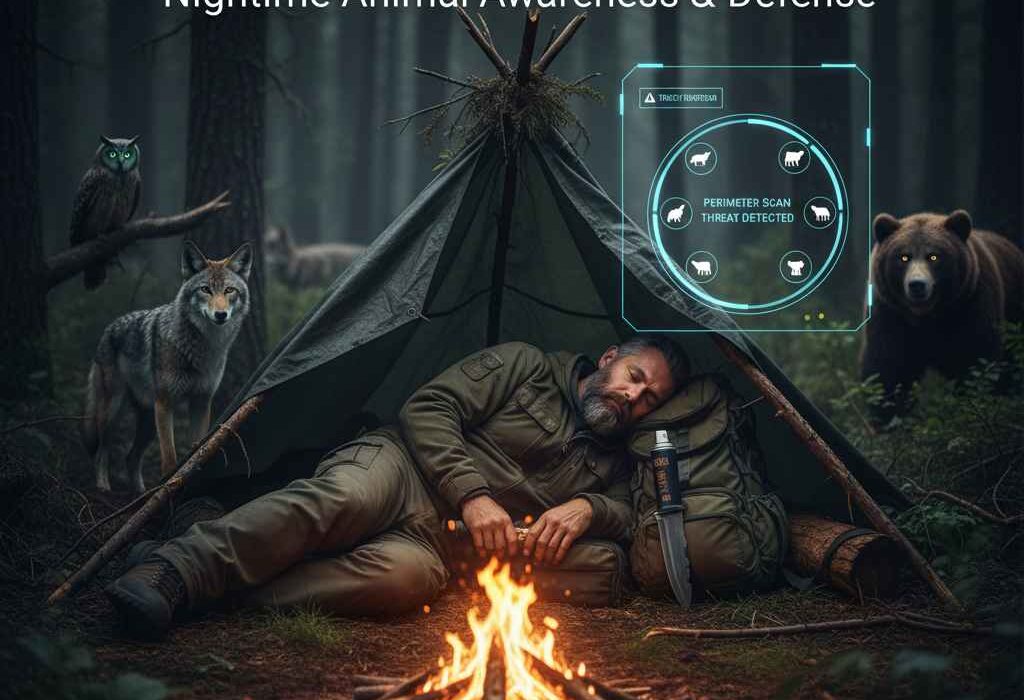
The wilderness doesn’t sleep just because you do. Nighttime is when many wild animals, particularly large predators and curious scavengers, are most active. Sleeping safely outdoors is less about defense and more about prevention: creating a campsite that is uninteresting, uninviting, and unscented to every animal in the vicinity.
Your best defense is a properly planned camp layout that respects the natural habits of local wildlife.
1. 🏕️ The Scent Triangle: Strategic Camp Layout
The single biggest mistake campers make is keeping their sleeping, cooking, and food storage areas together. This must be separated into a “scent triangle.”
A. Sleeping Area (The Clean Zone)
- Location: Your tent must be completely free of any scent that could be construed as food.
- Rule: Never bring food, cooking gear, or any scented toiletries (toothpaste, deodorant, hand sanitizer) inside the tent.
- Tip: Store the clothes you cooked in overnight in an airtight bag and hang them with your food.

B. Cooking Area (The Contamination Zone)
- Location: Cook at least text{200 feet} (sim 60 meters) downwind from your sleeping area.
- Action: Immediately clean up. Wash dishes thoroughly with biodegradable soap. Scatter the grey water (dishwater) over a wide area, at least text{200 feet} away from your tent and any natural water sources.
C. Food Storage Area (The Containment Zone)
- Location: Store food at least text{100-200 feet} from your tent.
- Rule: Use a bear-resistant canister (mandatory in many areas) or employ a proper bear hang. The cache must be suspended at least text{10 feet} high and text{4 feet} away from the tree trunk. This applies to all smelly items—not just food.
2. 🗺️ Location, Location, Location
Choosing the right campsite can prevent encounters before they start.
- Avoid Animal Corridors: Never camp directly on a well-worn animal trail, a game path, or a dry creek bed, as animals use these as natural highways.
- Avoid Water Sources: Set up camp at least text{200 feet} from any stream, pond, or spring. Water sources are major feeding and drinking areas for all wildlife.
- Check the Ground: Look for animal tracks, droppings (scat), or signs of recent foraging. If you see fresh signs of large predators, move the site.
3. 🚨 Nighttime Defense and Deterrents
While prevention is key, having immediate defense options provides crucial peace of mind.
A. Noise Deterrents
- The Whistle: A loud safety whistle is an essential tool. Its sharp, unnatural sound is startling and often enough to deter curious animals without escalating the situation. Keep it tethered inside your tent.
- Air Horn: For areas with aggressive wildlife (like grizzlies), a pressurized air horn provides a massive sound blast that is highly effective at immediate deterrence.
B. Bear Spray (Last Resort Defense)
- Readiness: If camping in bear country, bear spray must be instantly accessible. Keep it either in the tent vestibule or right beside your sleeping bag, safety off.
- Direction: Know how to deploy it, and remember that spray is only effective at close range and must be directed at the animal’s face.
C. Perimeter Alarms (Non-Lethal)
- Trip Wire: A simple, rudimentary warning system can be set up by stringing lightweight fishing line or string around the camp perimeter and tying bells, empty cans, or metal items to it. Any large animal intrusion will cause a noise, waking you and alerting the animal to your presence.

4. 🛌 The Tent and Psychology
The physical tent is a crucial psychological and physical barrier.
- Secure Zippers: Ensure all tent zippers are completely closed. Tiny gaps can invite curious insects or small rodents like mice or raccoons.
- Stay Calm: If you hear an animal outside your tent, do not panic or scream. Speak in a calm, firm, and loud voice to let the animal know you are a human. Do not try to shoo it away aggressively; wait for it to move on. Running or making sharp, high-pitched noises can trigger a predatory or defensive response.
By mastering the Scent Triangle and preparing your immediate defenses, you ensure that your night in the wilderness is peaceful, predictable, and safe.