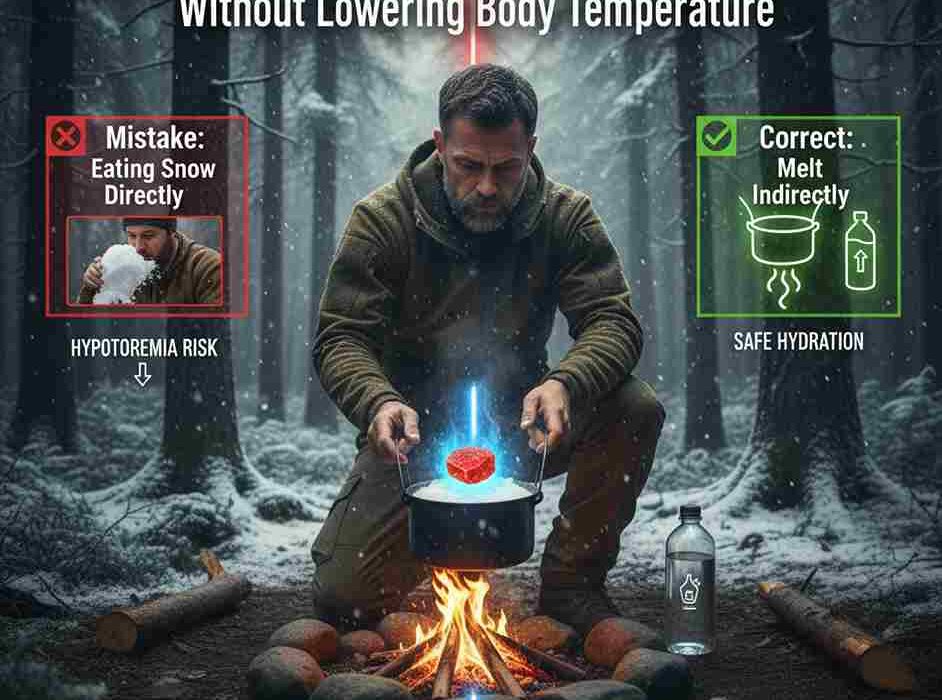
In a winter survival scenario, water is a critical resource, but snow and ice present a unique challenge. While they are abundant, consuming them directly is a tactical mistake. Eating snow lowers your core body temperature, forcing your metabolism to burn precious energy stores just to warm the ice, leading to an accelerated path toward hypothermia and energy depletion.
The rule is absolute: Never eat raw snow or ice to hydrate. You must melt it first, and you must do so efficiently.
1. 🌡️ The Science of Heat Transfer (Why Direct Consumption Fails)
Your body operates at 98.6circ F (37circ C). Snow is often below 32circ F (0circ C).
- The Cost: To melt just one liter of snow from $0^\circ C$ to body temperature, your body has to expend significant internal energy. This is a massive, unnecessary caloric drain in a survival situation where calories are your most valuable resource.
- The Danger: This constant internal cooling contributes to the overall chilling of the body, making you more susceptible to hypothermia, which impairs judgment and motor skills.
2. 🔥 The Melting Technique: The “Water Over Snow” Rule
When melting snow using a stove or fire, the biggest risk is scorching the snow, which produces a residue that is impossible to scrape off your pot.
A. Start with a Water Anchor
Always place a small amount of liquid water (even just a tablespoon) at the bottom of your pot or container before adding snow.
- Action: Start melting the liquid water first. Once it’s warm, add small amounts of snow to the water, stirring constantly.
- Why it Works: The water layer creates a buffer between the heat source and the snow, preventing the snow from burning or melting unevenly. The liquid water’s higher temperature melts the snow much faster than direct heat transfer alone.
B. Use the Right Snow
Not all snow is created equal for melting efficiency.
- Best Choice: Dense, granular, wet snow (found later in the day or closer to the surface). It melts down efficiently.
- Worst Choice:Fluffy, dry, fresh powder. This type of snow is mostly air and melts down to a tiny amount of water. You waste significant fuel and time melting a large volume for minimal return.
- Tip: Pack the snow tightly into your pot before melting to reduce air pockets.
3. ☕ The Safe Drinking Protocol: Adding Warmth and Energy
Once melted, the water is clean, but it’s often still very cold. Drinking large quantities of cold water can still cause an internal chill.
A. Warm It Up
Before drinking, warm the melted water to at least lukewarm. This ensures your body is not expending energy to heat the water.
B. Spike It with Calories
If you have any available resources, add a small amount of high-calorie, easily digestible fuel to the water.
- Ideal Spikes: Honey, sugar, dried fruit powder, or a minimal amount of bouillon (salt).
- Why it Works: This replaces some of the calories lost in the entire melting process and helps drive the warm liquid into your bloodstream faster. The salt or bouillon also replenishes lost electrolytes.
4. 📝 The Field Hack: Body Heat Melting
If you have no fuel (stove or fire) or are moving, use your body’s heat as a passive melter.
- The Vessel: Use a dark-colored, durable plastic or metal bottle.
- The Method: Fill the bottle with snow or packed ice. Place the bottle inside your layers, close to your core (e.g., in a large jacket pocket, or secured near your lower back).
- Why it Works: This is a zero-calorie-cost method. Your body is constantly radiating heat; this method allows you to harness that waste heat to melt the snow, providing you with lukewarm water without any energy expenditure. This process is slow but critical for energy conservation.
By respecting the science of heat transfer and adopting the “water over snow” method, you turn an icy liability into a vital, life-sustaining resource.