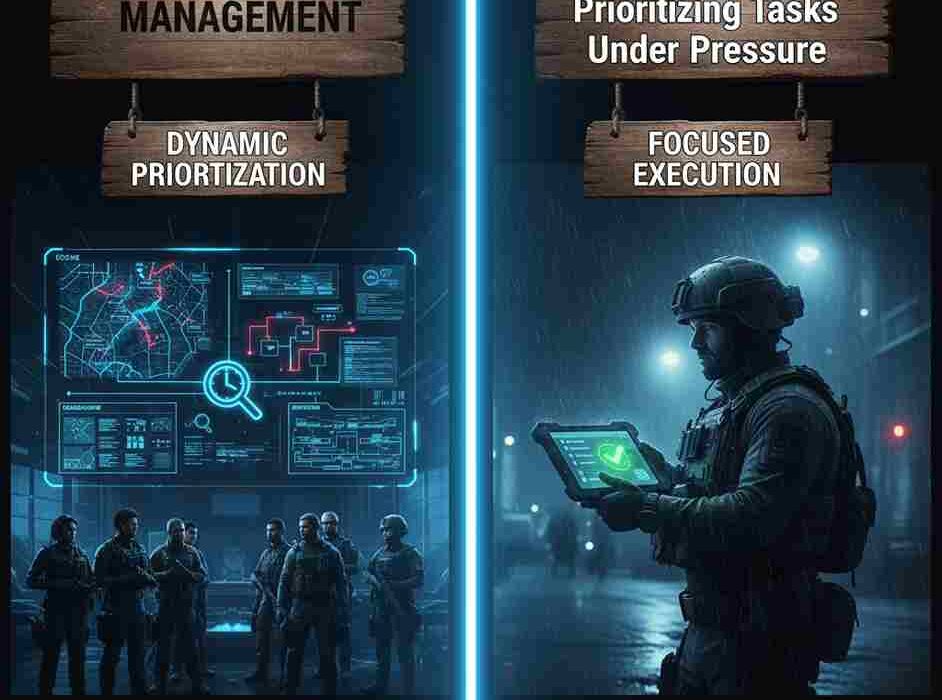
In a tactical or high-stress environment, time is the single most precious resource—and it’s always running out. A failure to prioritize correctly can lead to critical oversights, mission failure, or worse. Tactical Time Management isn’t about using a calendar; it’s about a disciplined, immediate, and ruthless assessment of tasks under duress. It’s the mental framework that allows personnel to transition from chaos to control by answering one critical question: What absolutely must be done right now to survive and complete the objective?
The Core Principle: The Life-Safety-Mission Hierarchy 🚨
Every decision in a high-stress scenario should be filtered through a clear, non-negotiable hierarchy. This simple structure ensures that the most important tasks are always addressed first.
- Life (Self-Preservation): This comes first. You cannot complete the mission if you are a casualty. Any action directly required for personal survival (e.g., seeking cover, clearing a weapon jam) is the immediate priority.
- Safety (Team/Casualties): Once personal survival is secure, the priority shifts to the team. This includes suppressing the threat, extracting a casualty from the kill zone, and establishing a defensive perimeter. The unit’s collective safety ensures the mission can continue.
- Mission (Objective Completion): Only after life and safety are addressed do you focus on the objective, such as gathering intelligence, securing a target, or executing a required maneuver.
This hierarchy dictates that an operator must prioritize getting to cover before attempting to fire and must ensure the team is secure before collecting evidence.
The “Four Ds” of Task Assessment 🎯
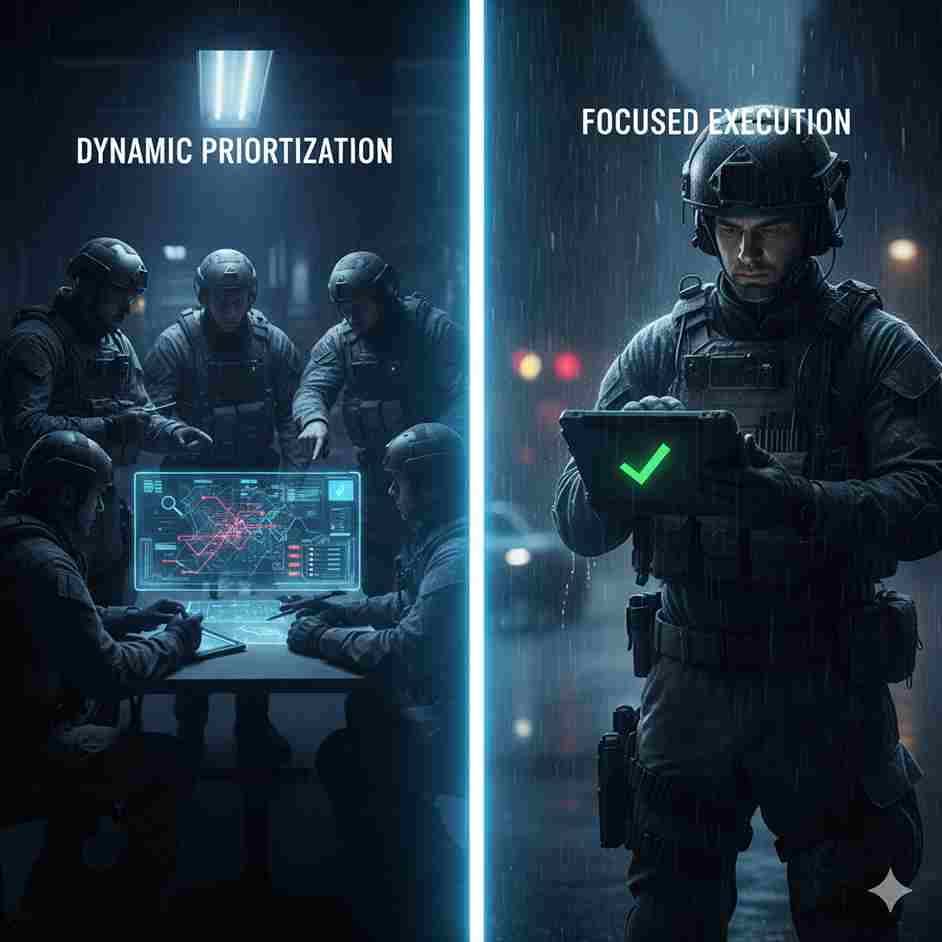
When a new task, a threat, or a complication arises, it must be instantly categorized to determine its fate. This is a rapid-fire mental exercise:
- Do It Now: Tasks that are Urgent and Critical (those that fit into the “Life” or “Safety” tiers). These are non-negotiable, high-impact tasks. Example: Suppressing fire against an active threat.
- Delay: Tasks that are Important but Not Urgent or must wait for a precondition to be met. These are queued for the next available window. Example: Gathering detailed intelligence after the area is secured.
- Delegate: Tasks that are Urgent but Can Be Done by Others. This is crucial for maximizing efficiency and reducing individual cognitive load. Example: Designating one person to handle radio communication while others maintain security.
- Discard: Tasks that are Neither Urgent nor Important (often distractions or low-priority tasks from the old environment). These are ruthlessly dropped to conserve resources and focus. Example: Fixing a minor cosmetic tear in gear.
The Time Management Tool: The 3-Minute Plan
In the most chaotic moments, discipline is often enforced by time itself. Many tactical and emergency response teams operate on a 3-Minute Plan framework:
- 0:00 – 0:30 (Initial Assessment): Identify the Trigger Event (the what) and instantly prioritize tasks using the Life-Safety-Mission hierarchy.
- 0:30 – 1:30 (Action and Communication): Execute the immediate “Do It Now” tasks and communicate the plan. This is the stage for establishing fire superiority or finding immediate cover.
- 1:30 – 3:00 (Reassessment and Transition): Check the status of the immediate threat. Was the first wave of action successful? Re-prioritize the next set of tasks (the “Delay” and “Delegate” items) and transition to the next tactical phase (e.g., moving from an attack to securing a perimeter).
Tactical time management is about replacing panic with practiced efficiency. By pre-loading these simple, prioritized decision models, operators ensure that their actions are always aligned with the highest priority: keeping the team safe and winning the fight.