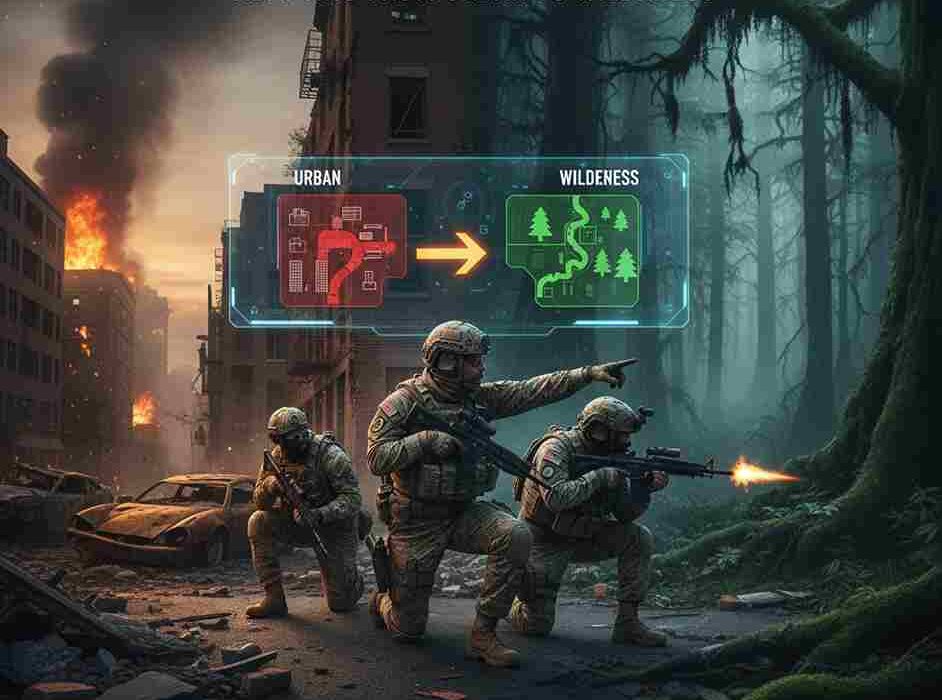
Survival, whether in a strategic sense or a literal one, is rarely confined to a single environment. The transition from the high-speed, high-density Urban Environment to the unpredictable, resource-dependent Wilderness requires more than just a change of gear—it demands a total shift in mindset, tactics, and risk assessment.
This is a guide to the crucial psychological and tactical shifts necessary to execute a successful multi-environment adaptation.
1. 🧠 The Psychological Pivot: From Scarcity to Resourcefulness
The most immediate danger during a transition is the failure to adjust the mental operating system.
A. Urban Mindset: Scarcity & Speed
The urban environment trains us to value speed, convenience, and pre-packaged solutions. Resources are immediate (stores, ATMs), but space and time are scarce.
- The Trap: Carrying this mindset into the wilderness leads to panic when resources are not immediately visible, and frustration with the slow pace of natural skill-building (e.g., spending an hour building a fire).
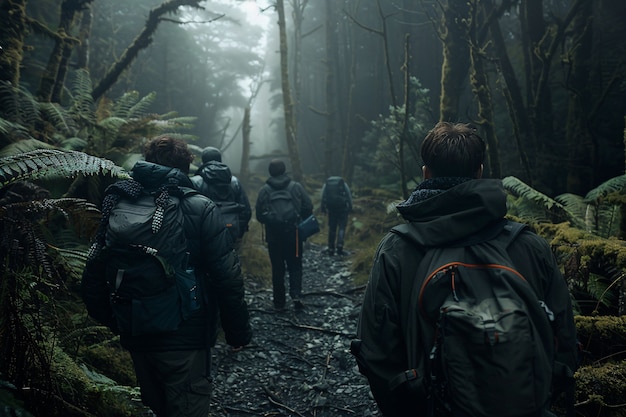
B. Wilderness Mindset: Abundance & Patience
The wilderness requires valuing patience, observation, and decentralized resources. Resources are abundant (water, fuel, shelter materials), but they require labor and knowledge to acquire.
- The Shift: When transitioning, force yourself to slow down. Replace the question “Where can I buy this?” with “How can I make or find this?” This shift turns the brain from a consumption mode to a production mode.
2. 🗺️ Tactical Adaptation: The “Three S” Transition
Tactical adaptation centers on the three most critical survival elements, which change dramatically in value and availability.
A. Shelter: From Structure to Site
| Environment | Goal | Tactic |
| Urban | Security & Concealment | Use existing structures (buildings, tunnels, abandoned spaces). Prioritize layered doors and minimal sightlines. |
| Wilderness | Insulation & Protection | Prioritize Site Selection (dry, sheltered from wind, near water/fuel). Shelter is built for heat retention and weather defense. |
| The Shift: In the city, your greatest asset is the building’s integrity. In the wilderness, your greatest asset is the natural insulation of the site (e.g., under an evergreen, against a rock face). |
B. Safety: From People to Predators
| Environment | Primary Threat | Immediate Tactic |
| Urban | Human Threat (unpredictable, organized, social). | Low profile, concealment, and maintaining awareness of sightlines and crowds. |
| Wilderness | Environmental Threat (wildlife, weather, terrain). | Awareness of animal sign, water filtration protocols, and rigid adherence to fire/footing safety. |
| The Shift: When leaving the urban environment, the security focus must move from covert avoidance (not being seen by people) to overt detection (seeing and avoiding hazards like unstable ledges or bears). |
C. Supplies: From Pack to Processing
| Environment | Key Resource | Focus |
| Urban | Contained Resources (pre-packaged food, bottled water). | Focus on portability and low-profile carriage. |
| Wilderness | Processable Resources (wild edible plants, unfiltered water). | Focus on processing skills (fire, filtration, tracking) and the tools required to utilize them. |
| The Shift: The urban bag is heavy with consumables. The wilderness bag must be heavy with multi-use tools (e.g., filtration straw, steel knife, cordage) that allow you to convert raw materials into survival necessities. |
3. 🔑 The Rule of Redundancy: Maintaining the Bridge
When transitioning, always carry resources that bridge the two environments, providing redundancy until the new mindset and skills take over.
- Communication Redundancy: Carry both a means of urban communication (a charged phone) and a means of wilderness signalling (a whistle, signal mirror).
- Fuel Redundancy: Carry an urban fuel source (a lighter/butane) and a wilderness fuel source (a ferro rod/fire starter) until you are confident in local wood conditions.
- Water Redundancy: Carry a small amount of sealed water (urban security) and immediate means of filtration (wilderness necessity).
The successful survivor is not the one who masters a single environment, but the one who can seamlessly and quickly shift their entire reality—their perception of risk, the value of their time, and their definition of a resource—to match the ground beneath their feet.